
Kings County Recent Arrest Channels
Kings County and Brooklyn name the same ground. New York City agencies hold the records, though. The NYPD makes the arrest paperwork. City jail custody data only appears once DOC admits a person. Courts take over after arraignment. No county jail, county police roster, or borough-wide arrest list exists. That gap matters. A desk appearance ticket can end police custody early. So can bail or release on recognizance. Either way, DOC may never log the person.
Match the channel to your question. The Arrests Last 24 Hours page explains the same-day fallback when no live feed exists. The Police Blotter page covers multi-day datasets, local reporting, and archives.
| Window | Best official source | Key limit |
|---|---|---|
| Fresh arrest | NYPD precinct or records path | No public live person list |
| Current city custody | NYC DOC Inmate Lookup | Admission may lag 48 hours or more |
| Older arrests | NYPD arrest datasets and FOIL | Published data are delayed and not a mugshot feed |
Arrested Last Night in Brooklyn
A fresh Brooklyn arrest does not land in any public Kings County booking feed. Hours pass before anything does. The NYPD processes the person at a precinct first, and custody details surface only later. Start with the arresting precinct when you know it. If the person may have been held after arraignment, check the official NYC DOC Inmate Lookup next. DOC warns that arrest-to-housing entry can take 48 hours or more. For a named person already in custody, the VINELink Custody Check adds release or transfer alerts. A missing result means just that. It is not proof that no arrest occurred.
The delay tracks real steps, not a slow website. Fingerprints and a photograph happen at the precinct. A prosecutor then reviews the case, and the court decides whether the person is released or held. An eligible person may get a Desk Appearance Ticket, often called a DAT, and never enter a DOC facility. Release on recognizance, or ROR, means a promise to return to court. Bail can also be posted before DOC has any useful custody data.
There is no published daily upload hour for Kings County recent arrests. No weekend batch exists, and no holiday schedule either. Court hours tell you nothing about it, and neither do state-prison maintenance periods. When the search is urgent, run the precinct, court, and DOC channels in parallel. Keep the person's full name, birth date, arrest date, NYSID, or Book & Case Number ready.
Kings County Current Custody Search
The citywide NYC DOC locator is the closest thing to an official roster. It covers everyone DOC currently holds. That includes Rikers Island jails and hospital prison wards. It is not a list of all Brooklyn arrests. Search with a strong identifier, and treat name-only matches with care.
| Search field | Use |
|---|---|
| NYSID | New York State identification number |
| Book & Case Number | DOC city-custody identifier |
| First and last name | Broader search when no identifier is known |
- Open the official DOC locator and choose the strongest search key.
- Compare the name, identifiers, court data, and holding location.
- Check again after the documented intake lag if the arrest was very recent.
- Use NYPD or court records when the person was released before DOC admission.
The lookup returns identity, custody, case, bail, court, and facility fields. It shows no booking photo. The DOC media policy states plainly that the agency does not supply mugshots. There is no Kings County sheriff booking app either. The NYC Sheriff handles civil enforcement and runs no arrest roster. Custody state decides which record stays useful after the first search.
| Status | Likely source | What changes |
|---|---|---|
| Police processing | NYPD precinct or police record | DOC may have no entry yet |
| Held after arraignment | NYC DOC lookup and VINE | Current custody fields may appear |
| Released | NYPD record and court case | Current DOC search may no longer answer the question |
| Sentenced to state prison | New York State DOCCS | State locator replaces city custody search |
| Federal or immigration custody | BOP, U.S. Marshals, or ICE | City and state locators do not cover the status |
A result can point to a Rikers Island facility or a DOC hospital prison ward. The official facilities list includes several Rikers jails in East Elmhurst plus wards at Bellevue and Elmhurst. No operating Brooklyn county jail appears on it. A new borough-based jail is under construction at the former Brooklyn detention site, but that project is not a current custody source. Trust the facility named in the live DOC result. The official DOC lookup interface is pictured below.
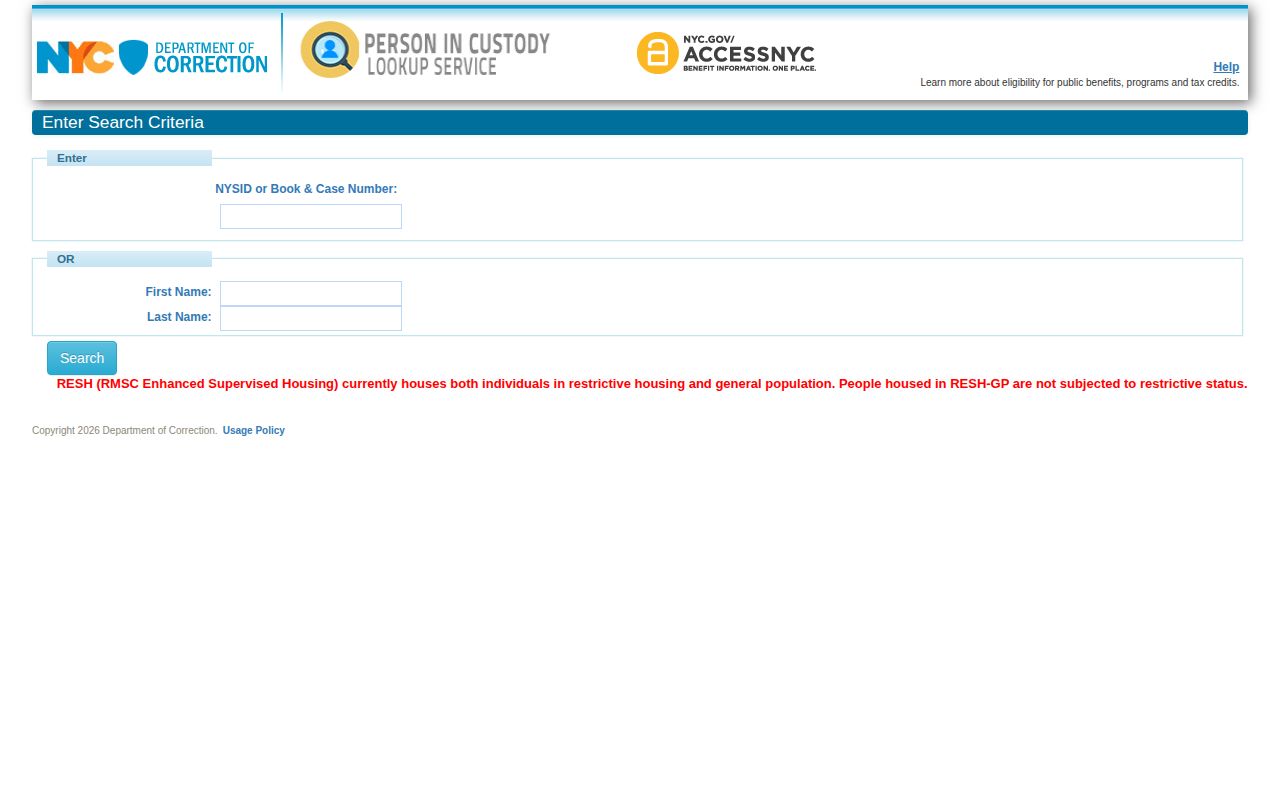
The image identifies the city's custody tool without showing any booking photograph.
Kings County Official and News Sources
Official sources should lead every search. Each answers a different question, and none of them merge into a single complete Brooklyn arrest roster.
| Channel | Photo | Status | Use |
|---|---|---|---|
| NYC DOC Lookup | No | Official | Current city custody |
| NYPD arrest data | No | Official | Delayed row-level and trend data |
| New York courts | No | Official | Case status and disposition |
| Brooklyn Paper, Brooklyn Eagle, News 12 | Story dependent | News | Selected incidents, not a complete log |
| Major mugshot aggregators | Varies | Unofficial | No verified current Kings County local section found |
The official NYPD year-to-date arrest dataset serves research, not same-day lookups. It carries no booking portraits. Current-year data is updated by quarter. The historic dataset moves on an annual cycle, and citywide crime statistics follow a weekly cadence. None of it says whether a named person is in custody right now.
Brooklyn Paper, Brooklyn Eagle, and News 12 Brooklyn run selected arrest stories. These are editorial products, not police logs. A report may follow an agency statement by days. It might show a scene image rather than an intake photo, or skip an arrest that drew no news value. For old coverage, Brooklyn Public Library's Brooklyn Newsstand is an archive, not a live feed.
RecentlyBooked, Busted Newspaper, Arrests.org, Mugshots.com, and Mugshots.zone are aggregation sites. None carries a current, verified Kings County local page. Their material can be stale, misidentified, or lifted from another jurisdiction entirely. A page about a closed Brooklyn detention complex is the weakest current source of all.
One outdated Brooklyn detention listing shows why an unofficial result needs an official check. It describes a former facility. Do not read it as a live Kings County roster. It is no booking-photo source either.
Recent Arrests by Brooklyn
Brooklyn Recent Arrests is the only honest city-map page here. Kings County holds no second or third incorporated city. NYPD patrol precincts make arrests across the borough. NYC DOC becomes the custody source once a person lands in the city jail system.
What Kings County Arrest Records Show
No single public card holds every field. NYPD, DOC, and the courts each keep a separate layer, so a Kings County arrest record must be read by source and by date.
| Field | What it shows |
|---|---|
| Name and date of birth | Identity clues; a name alone is not proof |
| Arrest date and precinct | Police event and place |
| NYSID or Book & Case Number | Cross-system or DOC custody identifiers |
| Charges as booked | Initial charges that may change |
| Bail, court, holding location | Current custody and appearance details |
| Disposition | The later court outcome |
Charge codes need context. A custody screen may shorten what police wrote, and prosecutors can file a different count after review. A Book & Case Number marks a DOC custody matter. The docket code KN stands for Kings County in the DOC glossary. An NYSID is a state identification key. Having one does not mean the person is serving a state-prison sentence.
Does a blank roster settle the question? No. The person may still be in police processing, released before DOC admission, held by another system, or simply delayed in appearing.
Kings County Booking Photo Limits
NYPD processing may include a photograph. NYC DOC publishes none in its custody lookup. The agency says it does not supply mugshots at all. DOCCS lookup covers sentenced state prisoners, and its current interface shows no public photo. So a police-record request is the main official route to a Brooklyn booking photograph. FOIL access still runs into sealing, privacy, juvenile, safety, and active-investigation limits.
New York has no enacted mugshot-publication statute. There is no pay-to-remove law either. Public access turns on FOIL and Criminal Procedure Law sealing rules instead. An unofficial copy may omit the final court result. It can sit stale. It can even confuse Kings County, New York with Kings County, California.
For the governing analysis, read the Committee on Open Government advisory opinion. It walks through how FOIL treats police photographs.
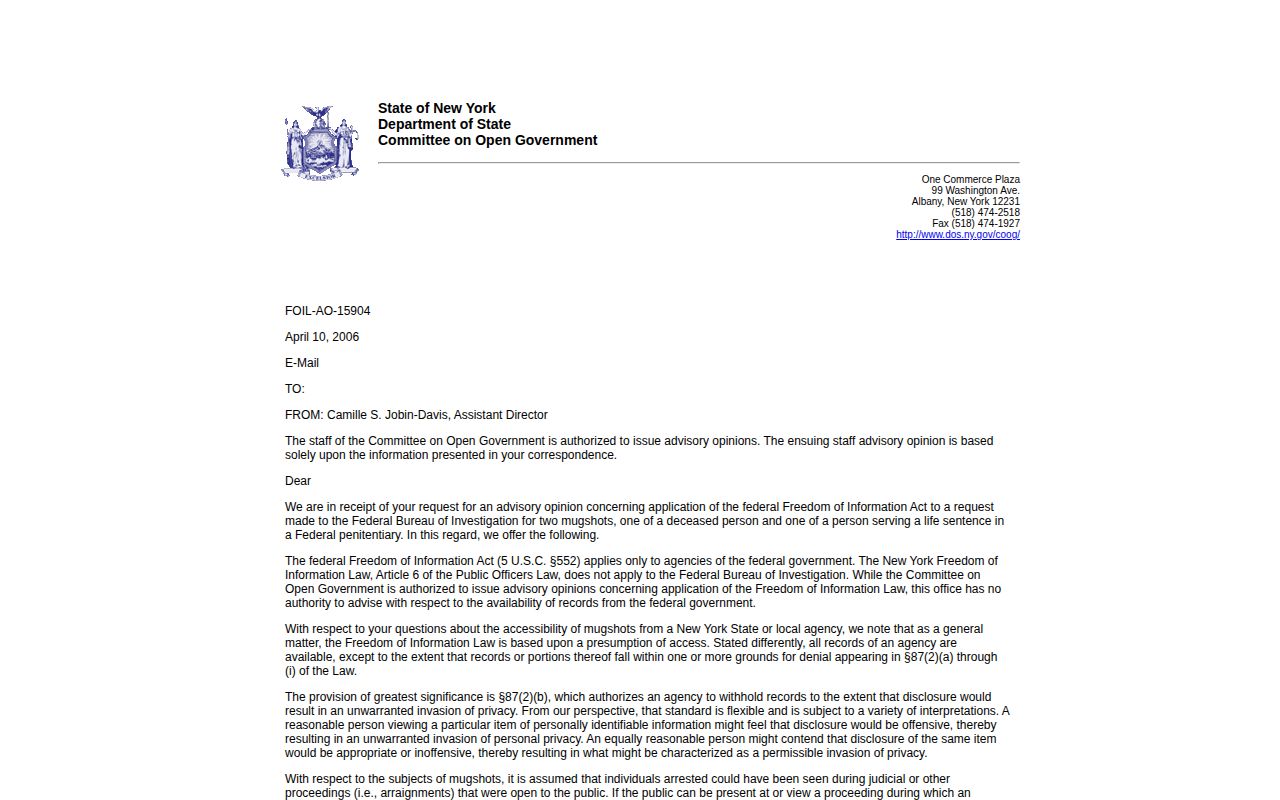
An advisory opinion is legal context, not an image feed, and each request still turns on the record and its exemptions. A face on a third-party site adds no authority. That copy may lack the arrest number. It may skip a sealing. It may miss a dismissal entirely. Compare any booking photo against the official police record and the later court result.
Request Kings County Arrest Records
File a police arrest-record or photograph request with NYPD through NYC OpenRecords or the NYPD Legal Bureau FOIL route. A city-jail custody request goes to NYC DOC instead. Give enough detail to identify the record.
- Identify the creator: NYPD, NYC DOC, a court, DOCCS, or a federal agency.
- Give the full name, date of birth, arrest date, precinct, and known identifiers.
- Describe the exact record or photograph and a useful date range.
- Ask for electronic delivery and cite New York FOIL.
- If access is denied, read the exemption and appeal instructions before responding.
FOIL sets copying fees. The general cap is 25 cents per page for pages up to nine by fourteen inches, while other formats may be billed at actual cost. NYC DOC's published rate is 25 cents a page. No fixed photo fee or universal response time exists. Agencies acknowledge requests and give a reasonable estimate.
NYPD prefers a full arrest number when you have one. Without it, offer name, date of birth, NYSID, arrest date, and precinct. DOC requests stay with DOC. Court papers belong with the clerk. Routing each ask to its creator avoids a broad request no office can answer.
A denial must name its ground. Active-investigation, privacy, juvenile, and sealing rules can all block access. FOIL grants a right to ask. It does not promise every intake photo comes out. When part of a record is withheld, ask for the reasonably segregable portion.
New York FOIL and Sealing
Exemptions exist. Public Officers Law §87 opens agency records to the public but permits carve-outs. Section 89 governs procedure and privacy. Favorable termination can trigger sealing under CPL §160.50, including return or destruction of specified photographs and identifying material. Conditional sealing for some older convictions sits in CPL §160.59 once statutory conditions are met.
Copies already held by an unofficial publisher follow a different route, so use that site's free correction or opt-out process where one exists. RecentlyBooked publishes a free removal policy. Other sites offer correction or removal routes with different conditions. No caller can guarantee deletion from government systems. Never pay one. After a source page changes, Google's outdated-content tool or the search engine's legal-removal route may address an old snippet, though search indexing never alters the underlying official record.
Order matters. Get the disposition or correction first. Ask the source to update what it can lawfully change, then confirm the source URL actually changed. Only then should a search engine be asked to refresh the old result. A stale-result tool cannot remove a live page. A publisher's voluntary policy does not seal the police or court record either.
Retention runs series by series. State Archives guidance lists permanent master summaries of commitments and discharges, while other prisoner data and case files follow different schedules. A missing web result does not prove destruction. Historical Brooklyn reporting may also survive in the Brooklyn Newsstand.
The RecentlyBooked free removal policy appears here only to document a secondary publisher's stated process.
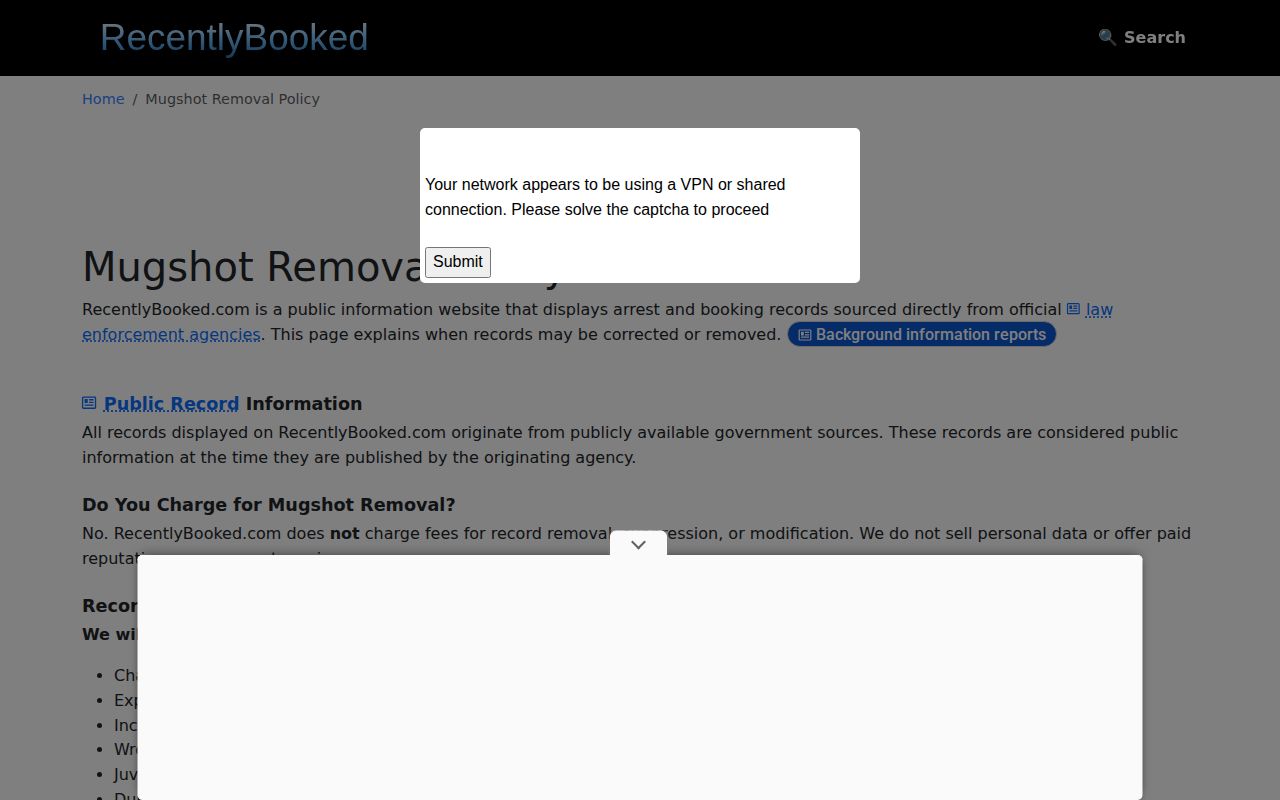
No Kings County local section exists on that publisher's site. Its policy is not New York law or a court disposition.
Protected Kings County Records
Some gaps in a Kings County search exist because the law demands them. DOCCS excludes youthful-offender records from its state-prison lookup. NYPD guidance restricts the use of juvenile police photographs. A favorable ending can seal records under CPL §160.50. These limits protect defined records and people, not signs of a lost file.
Juvenile and youthful-offender are not interchangeable labels. Juvenile records grow out of age-based systems and their rules. Youthful-offender treatment is a confidential court status that can replace an eligible conviction record. Public access can be sharply limited in both settings. Skip the unofficial name match. Skip the old image too. Its identity and case outcome cannot be verified.
Sealing is not deletion across the internet. It restricts official access and can control specified photographs, fingerprints, or copies. An old news story may remain under publisher rules. Start with the court when a record should be sealed. Obtain the order or disposition, then take that proof to each agency or publisher. That order keeps the legal outcome separate from a voluntary website fix.
Kings County Arrest Warrants and Tips
No public database searches every open Kings County warrant by name. NYC311 directs warrant questions to Criminal Court. It also points people to an attorney. NYPD Crime Stoppers posts selected wanted material and takes anonymous tips by web, phone, social account, and the CS-NYC app. That list is not a complete warrant index.
Use NYC311 warrant guidance to pick the court path. A person who believes a warrant exists needs legal advice and a safe resolution through the court. Never approach a wanted person. Never help someone dodge law enforcement. Tips go through NYPD Crime Stoppers.
NYPD's missing and wanted page and @NYPDTips carry selected flyers, photos, or video. These dynamic investigative notices form no stable Kings County most-wanted count. Crime Stoppers takes anonymous tips online or at 1-800-577-TIPS, with Spanish service at 888-57-PISTA. The CS-NYC app handles tips and wanted flyers. It is not a booking app and posts no recent arrests.
The NYC311 Crime Stoppers page keeps warrant tips tied to the official reporting channel.
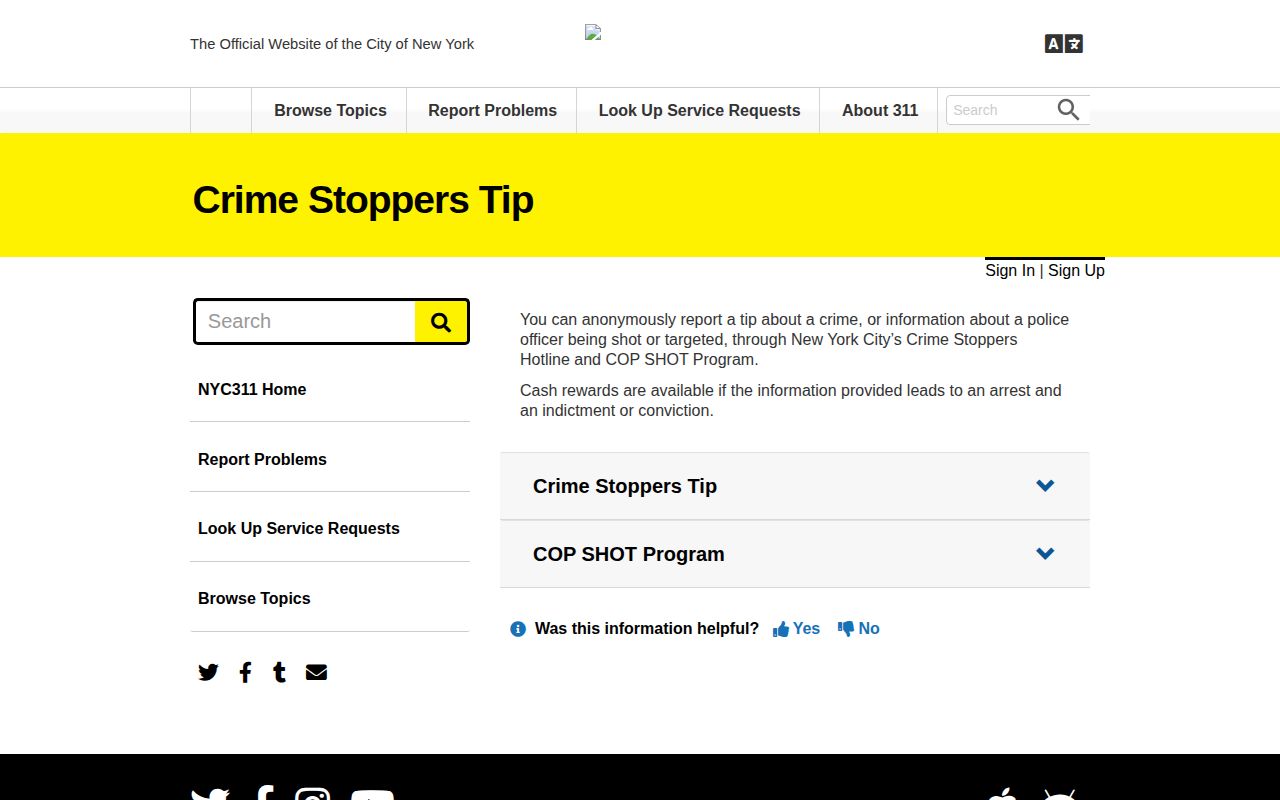
The official page supports safe reporting. It cannot confirm whether any warrant exists.
Kings County Arraignment to Disposition
Police processing comes first. A prosecutor then reviews the case. Arraignment follows, or another lawful release outcome. Kings County Criminal Court handles many initial matters, and felony cases may proceed in Supreme Court, Criminal Term. New York eCourts can supply case information, though some matters are excluded or delayed. The court's certificate of disposition is the official record of how the case ended.
- Arraignment
- The first court appearance on the charges.
- Bail
- A court-set condition for release; not a finding of guilt.
- Disposition
- The final recorded outcome, such as dismissal, acquittal, or conviction.
- Sealing
- A legal limit on access to a qualifying record.
Kings Criminal Court sits at 120 Schermerhorn Street. It handles misdemeanors and many initial felony matters. Arraignments run through nights and weekends there, which helps explain why court activity and a later DOC entry may not line up. Indicted felonies can move to Kings Supreme Court, Criminal Term, at 320 Jay Street.
The official Kings Supreme Criminal Term page gives the court location. It also covers clerk information.
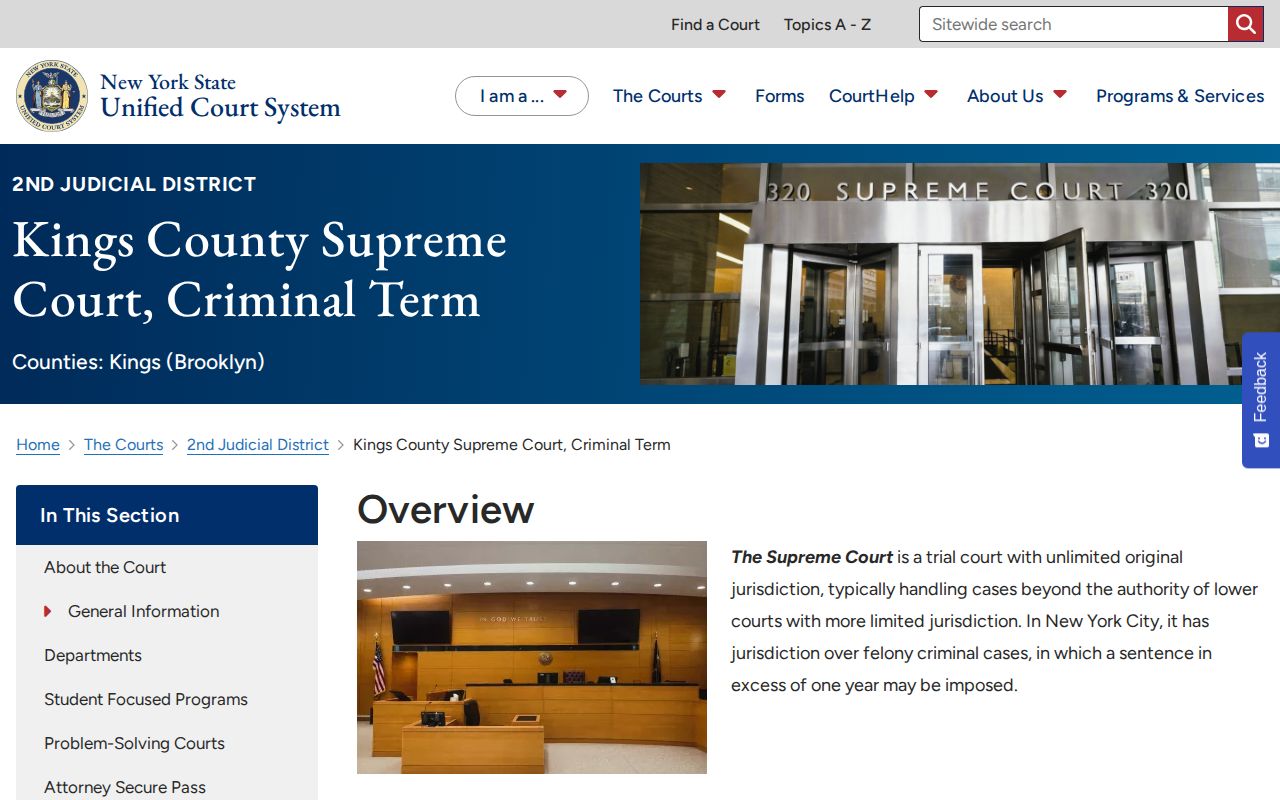
The court shows case progress and disposition, not a live Brooklyn booking roster.
Kings County Custody Beyond NYC
A state prison sentence moves a person out of the city jail system entirely. For those inmates, search the New York State DOCCS lookup by DIN, NYSID, or name. It skips certain record types. It is not a fresh-arrest source either. Federal custody works differently; the BOP locator tracks federal prisoners from 1982 forward, though it shows no public photo. Immigration detention has its own tool, the ICE detainee locator, which accepts an A-Number with country of birth or plain identity details. Someone held by the U.S. Marshals may not surface in BOP results yet. Each system tracks one status, and none offers a Kings County mugshot feed.
The DOCCS database excludes youthful offenders, reversed convictions, and other records pulled under state rules. So a blank result means little on its own. Older files may sit elsewhere entirely. New York State Archives keeps incomplete state-prison series. NYC Municipal Archives routes city-record requests by agency and record type instead. Start with whichever system created the record. Then check whether a retention schedule moved it somewhere else.